
Before you start
Think through a normal day: where do your bag, blanket and paperwork end up? Note three spots. Measure available gaps and the clearance doors or drawers need to open. Keep walking routes clear.
Use space under furniture selectively
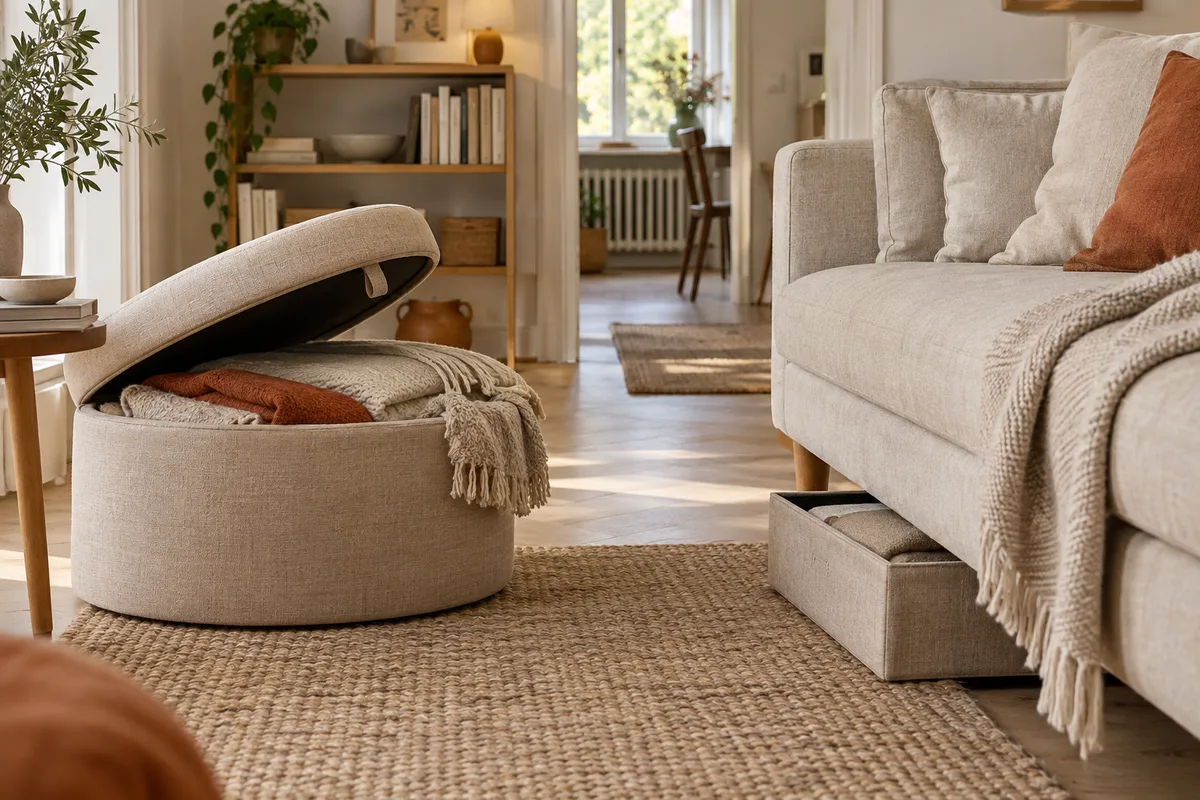
A shallow container under a bed or sofa can hold things you use less often. Measure the height, depth and space needed to pull it out. Keep any ventilation clearances specified by the furniture manufacturer.
Try it before buying
Slide an empty, suitably sized box underneath first and check that you can remove it without moving furniture.
Create a small arrival zone
Keys and bags need a home close to where you naturally leave them. Use an existing bowl or spare shelf. Avoid adding furniture if it narrows the entrance.
Try it before buying
Watch where things land for three days, then set up a small permanent space there.
Combine storage with a furniture function
An existing furniture compartment can hold blankets or games. Check its internal dimensions and how the lid or doors open. A storage box is only suitable as a seat if it was designed for that use.
Try it before buying
Assign one existing compartment to one group of things and check that you can reach the contents comfortably.
Keep one activity in one container
Knitting, board games or stationery can stay together in a portable box. Carry everything to where you use it, then return it together. The filled container should be comfortable to lift.
Try it before buying
Put the materials for one activity in a basket you already own and try the whole carrying route.
Leave some space unfilled
A little spare room makes putting things away easier and helps prevent new piles. If a door only closes with pressure, rearrange or reduce the contents. Another container does not automatically solve having too much.
Try it before buying
Reorganise a shelf so you can take out each frequently used item without unpacking everything else.
Three everyday situations instead of more cupboards
These examples describe routines you can adapt, not a room plan drawn to scale. Start with the problem that happens most often. Check existing furniture before taking up more floor space.
A zoning principle, not to scale. Check door movement, actual walkways and ventilation in your room.
- Keys and a bag end up on the dining table: place a tray in a free compartment near the entrance and assign an accessible spot to the bag. Walk your usual route home through the room. If the new spot requires a detour, move it onto that route rather than immediately planning another hallway unit.
- Hobby materials need clearing away each evening: put one current project and its tools in a portable container. Measure its home and check its filled weight. It needs a fixed return spot; leaving it on the floor beside the table only moves the problem.
- Reserves crowd out daily items: gather spare supplies in a suitable place and list what you have. Bring daily things back within reach. Shallow containers under furniture work only when the contents, ventilation and pull-out path suit the location; do not store sensitive supplies against their packaging instructions.
The take-it-out-and-put-it-back test
Extra storage helps only if both directions work. Test a proposed spot with an existing container and the actual contents. An empty cardboard box shows the dimensions, but not the weight or everyday handling.
- Approach and open the container as you normally would. Doors, lids and drawers must not block other objects or a walkway.
- Take out a frequently used item. Do you need to move furniture, lift several boxes or reach awkwardly? Simplify access.
- Put it back without rearranging everything inside. Leave some handling space instead of filling each compartment to the brim.
- Repeat with other people who use the storage. Comfortable reach and carrying weight are not the same for everyone.
Try it for a week and adjust one thing
Choose one of the three spots and observe a normal week. Note what stays outside and why. If a blanket is hard to return to an ottoman, reduce the contents or give it a more accessible home. If a hobby container is too heavy, divide materials according to what you actually use together.
Do not automatically buy the largest box. Its outside dimensions, including handles and wheels, must fit the space; its inside dimensions must fit the contents. A storage ottoman also needs to be explicitly designed for sitting. Check that you can still operate the lid beside the sofa or wall.
If every compartment remains full, quantity is a separate decision. Separate rarely used things from daily items and decide what you want to keep. Another piece of furniture is worthwhile only if its benefit outweighs the movement space it takes away.
Your checklist
Check these points before choosing a solution. Tick marks apply only to this visit.