
Sort
Keep your everyday spices within reach
Bring spices from the cupboard, drawer and worktop together. Separate open packets from spare stock, check labels and dates, and group duplicates. Do not combine different batches merely to create a matching display. Keep the original product information available.
Start with around 8–12 frequently used spices. This is a planning example, not a required number. Less-used blends can live in a separate box. What matters is returning each jar to the same place after cooking.
Try it at homeFor one week, place the spices you use on an existing tray. Its contents show how much space your everyday set actually needs.
Measure
Measure the inside, with the jars
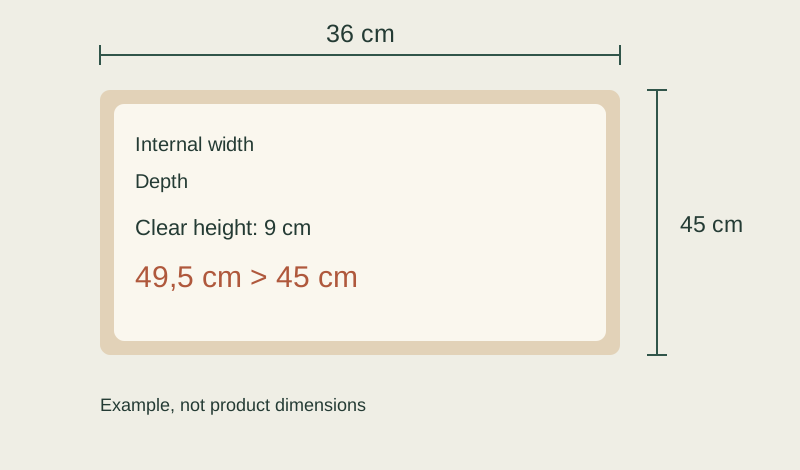
Record internal width, internal depth and clear height. Measure between the drawer sides, not across its front. Allow for hinges, runners and the structure above the drawer. Measure the largest jar with its lid and the widest packet you want to keep.
Example: an internal drawer of 36 × 45 cm with 9 cm clear height. A 49.5 cm long insert fails the depth comparison straight away. The height of an empty insert does not tell you whether the drawer will close with jars lying at an angle.
Try it at homeCut out a paper footprint of the accessory. Arrange your real jars on it in the intended position. Close the drawer gently, without pushing.
Drawer
Drawer: every label at a glance
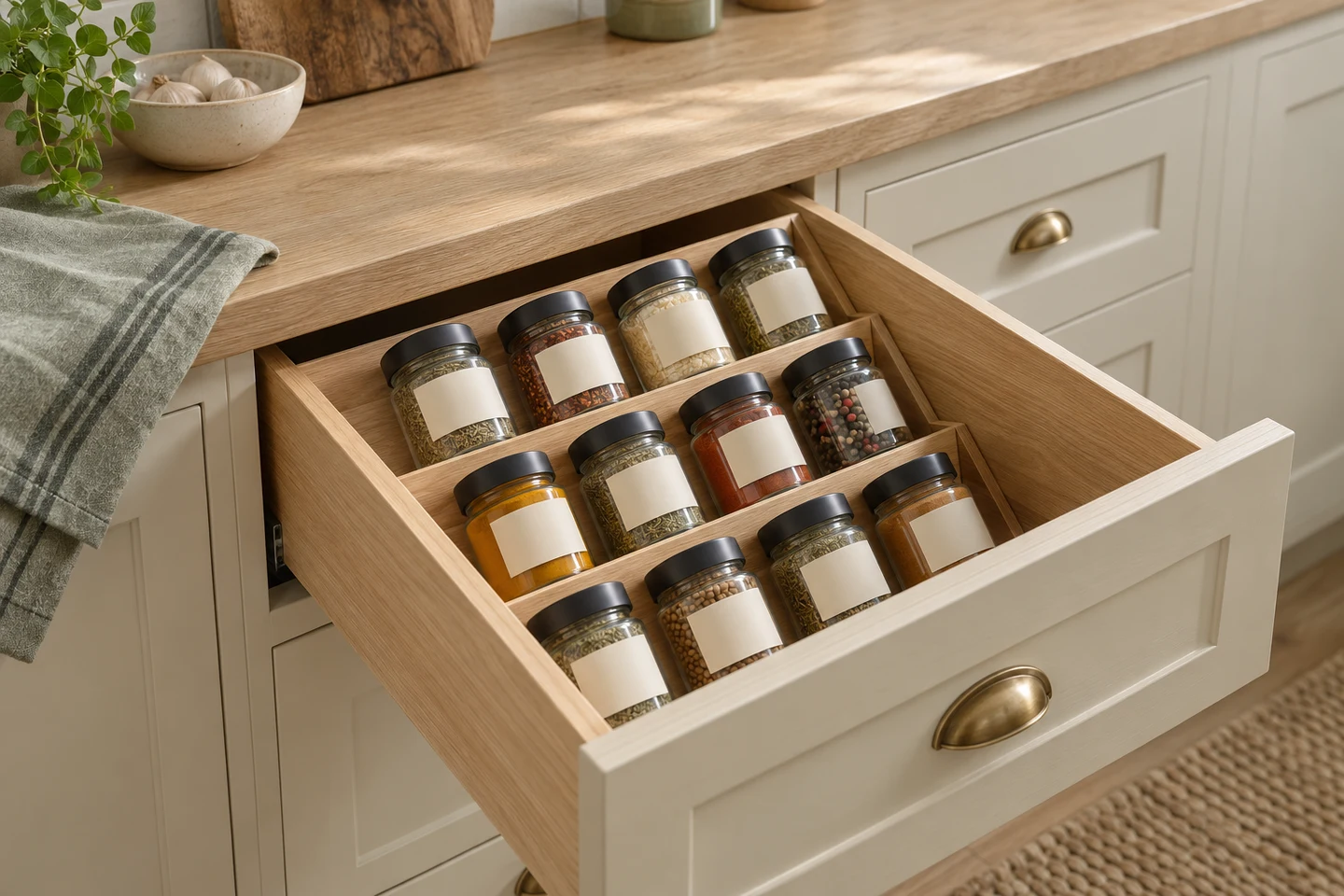
A spare drawer near your preparation area can hold jars with their labels facing up. Shallow, angled rows help keep names visible. Leave a separate area for taller containers instead of forcing every jar into the same system.
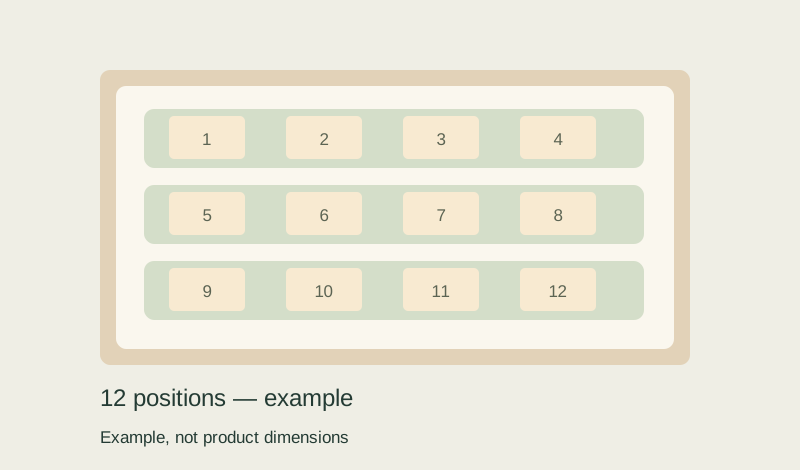
The diagram shows three rows of four positions. Twelve is only an example: capacity depends on your jars and their angle. With an inclined insert, dividing drawer width by jar diameter is not enough to establish capacity.
Try it at homeOpen and close the drawer several times. If jars slide, check fit and an anti-slip solution intended for that insert. Do not obstruct the mechanism with improvised padding.
Manufacturer details
Spice insert for a drawer
Choose an insert shorter than the measured internal depth. IKEA UPPDATERA 506.005.75 is 10 cm wide, 49.5 cm long and 2 cm high: a reference example that does not fit our 45 cm deep drawer.
Manufacturer details ↗Compare search results on Amazon.de ↗Advertisement / affiliate search link
Shelf
Shelf: raise the back row, not the whole collection
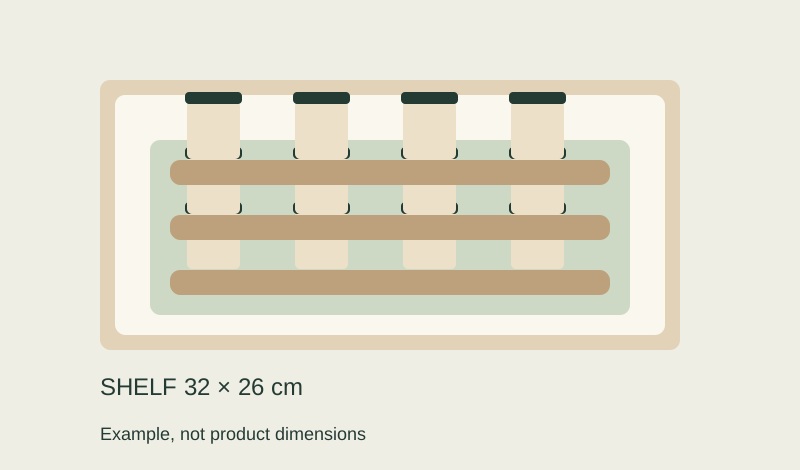
Keep everyday spices at the front and spare stock separately. A low stepped rack raises rear labels. A rotating base can help in a deeper cupboard, but needs space for its full movement and your hand beside the door.
Our shelf example measures 32 × 26 cm. The two-tier CupboardStore 85196 is not suitable for that space: the manufacturer requires cupboard width and depth over 33 cm. Product body dimensions do not replace its required working area.
Try it at homeTry a cardboard footprint, reach for the furthest jar and check door movement. If one jar requires removing everything, two small trays may work better.
Optional accessory
Low stepped rack
Compare the total height with jars and the depth of each step. Wide lids do not automatically fit narrow steps.
Compare search results on Amazon.de ↗Advertisement / affiliate search linkManufacturer details
Joseph Joseph CupboardStore 85196
A rotating option to compare. Body dimensions: H20.2 × W33 × D28 cm. The manufacturer requires cupboard width and depth over 33 cm.
Manufacturer details ↗Compare search results on Amazon.de ↗Advertisement / affiliate search link
Trays and labels
Two trays and readable labels may be enough
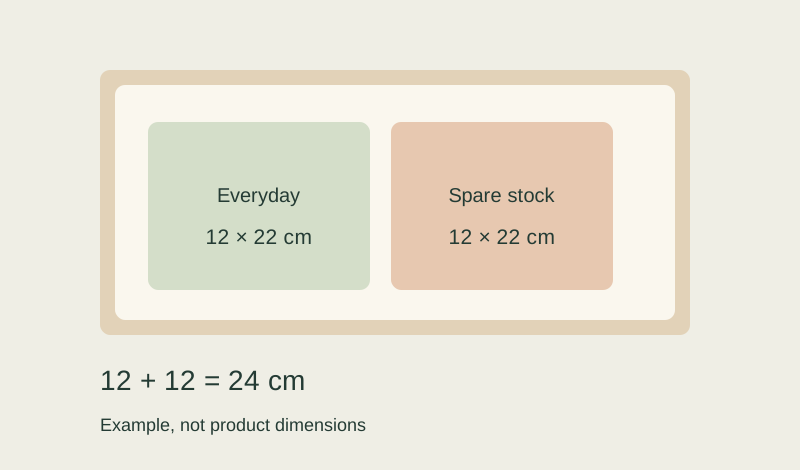
Separate jars and packets in a narrow cupboard. One shallow tray contains everyday spices; the other holds spare stock. Two trays with external dimensions of 12 × 22 cm each occupy 24 × 22 cm side by side. A 32 × 26 cm shelf leaves a nominal 8 cm in width and 4 cm in depth.
This only compares footprints. Handles, rims and finger space reduce the useful spare room. Stand packets upright with names visible. Matching jars are optional: a lid label can be enough when viewed from above.
Try it at homeWhen decanting, keep the name, date and necessary information from the original packet. Use containers suitable for food and follow label storage instructions. Avoid spots continuously exposed to steam.
Optional accessory
Shallow trays with handles
Compare external dimensions including handles. Choose a tray you can comfortably remove and clean.
Compare search results on Amazon.de ↗Advertisement / affiliate search linkOptional accessory
Labels for jars or lids
Check lid size, readability and whether labels can be removed. Keep important original information visible.
Compare search results on Amazon.de ↗Advertisement / affiliate search link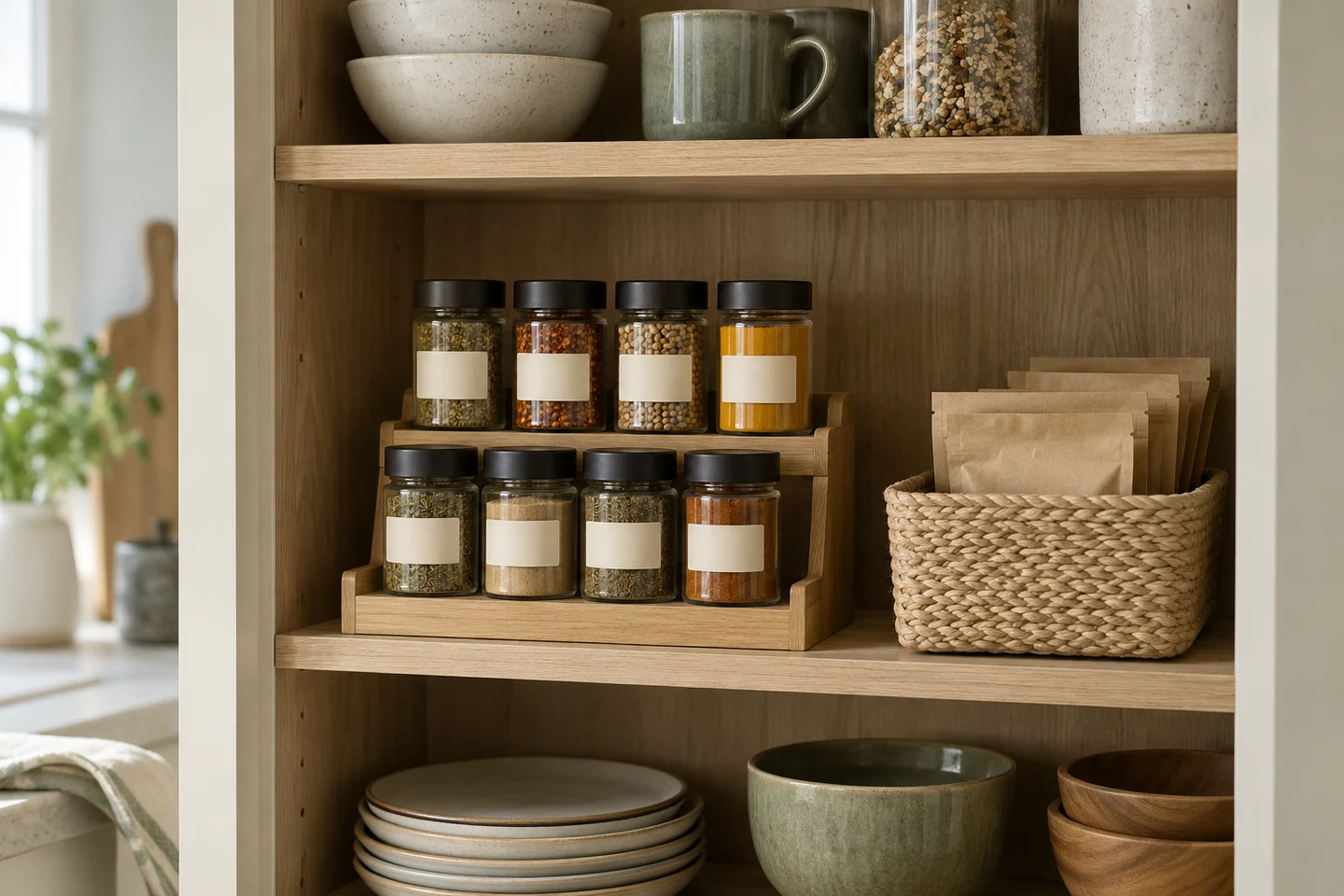
SHELF / TRAYS
Less searching. Easier cooking.
Separate jars and packets in a narrow cupboard. One shallow tray contains everyday spices; the other holds spare stock. Two trays with external dimensions of 12 × 22 cm each occupy 24 × 22 cm side by side. A 32 × 26 cm shelf leaves a nominal 8 cm in width and 4 cm in depth.
06 / Choose and check
Which layout suits you?
| Your situation | Start with | Check before buying |
|---|---|---|
| A spare shallow drawer | Labels facing up | Height with an angled jar |
| Hidden rear labels | A low stepped rack | Tallest jar and clear height |
| A deep, wide cupboard | A rotating base | Full rotation area and hand access |
| Jars and packets mixed | Two removable trays | Handles and finger space |
Accessories for a specific job
Results may include different models. Check dimensions, variant, pack size and delivery. Prices and availability are not confirmed.
CHECKLIST
Five checks before buying
Questions before choosing
Do I need a set of matching jars?
No. Organise your existing packaging first. Consider a set if its shape prevents your preferred layout and you are willing to transfer the necessary label information.
Can an under-shelf organiser be installed without drilling?
Only if that exact model’s instructions allow it on your surface. This guide uses freestanding inserts, racks and trays; it does not replace screws with arbitrary tape.
What if I have no spare drawer or entire shelf?
Start with a small tray for everyday spices. Move spare stock to another suitable place and try the layout for a week. Removing duplicates can sometimes free more room than a new rack.
A good layout still works after dinner.
Choose somewhere that makes putting a spice back easy. Use it for a week, then expand only when you know what is missing.
Also read: organise kitchen drawers →Sources and editorial method
An editorial guide with example measurements, not a product test. Dimensions of two models were checked with manufacturers on 4 October 2026. Diagrams are illustrative and the photograph is AI-generated. Other accessories are categories to compare, without a confirmed individual listing.
IKEA UPPDATERA 506.005.75 · Joseph Joseph CupboardStore 85196