
Match pairs
Match pairs before assigning storage space.
Put all empty containers and lids on a clear surface. Match each container with its lid and check the closure. Similar shapes do not guarantee compatibility: a lid that almost fits will not make the next search easier. Then group the pairs by shape and size rather than colour.
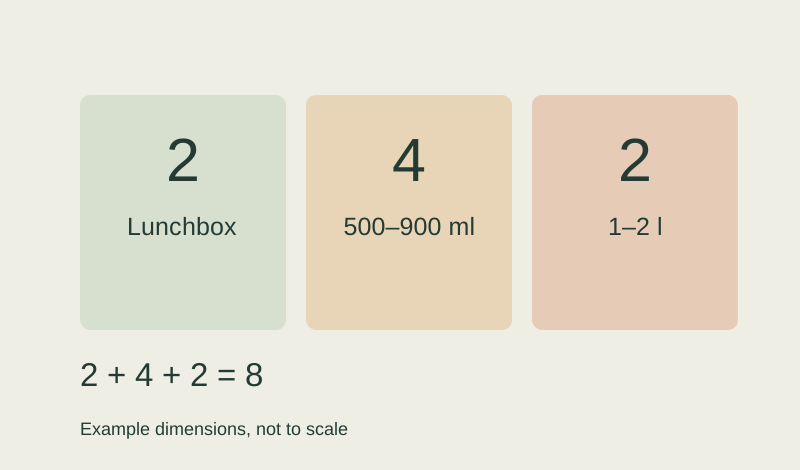
Separate an everyday set from large containers used occasionally. For a small household, you might start with two lunchboxes, four medium containers and two large ones. This is an example, not a target number. Preparing several meals at once may require more; washing up daily may require fewer. A container without a lid can serve another clear purpose. Avoid keeping it indefinitely in a pile of unresolved items.
Try it at homeFor a normal week, put only the pairs you actually use in the everyday zone. Move untouched items to reserve storage or let them go.
Measure carefully
Measure the space and the complete arrangement.
Measure clear width, usable depth and free height at the narrowest point. Hinges, drawer runners and an upper rail can reduce the space. For upright lids, measure the loaded holder; for nested containers, measure the finished stack. A low box does not make a tall lid shorter.
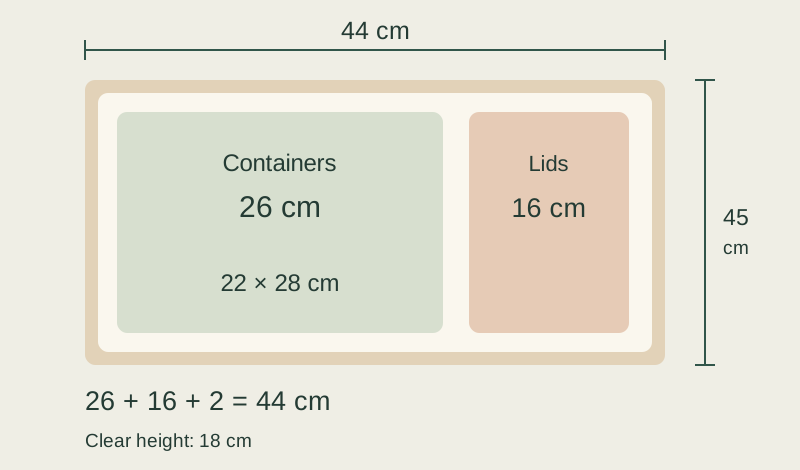
Example: a drawer has 44 × 45 cm inside and 18 cm of clear height. Allocate 26 cm across for containers, 16 cm for lids and 2 cm between them: 26 + 16 + 2 = 44. A stack with a 22 × 28 cm footprint fits in the left zone. On the right, the complete lid arrangement must stay below 18 cm. Check projecting rims, feet and the opening used to insert it. This calculation describes zones, not guaranteed product compatibility.
Try it at homeDraw the outer footprints on paper or cardboard and use your own containers to test them. Close the drawer slowly without forcing it.
Drawer layout
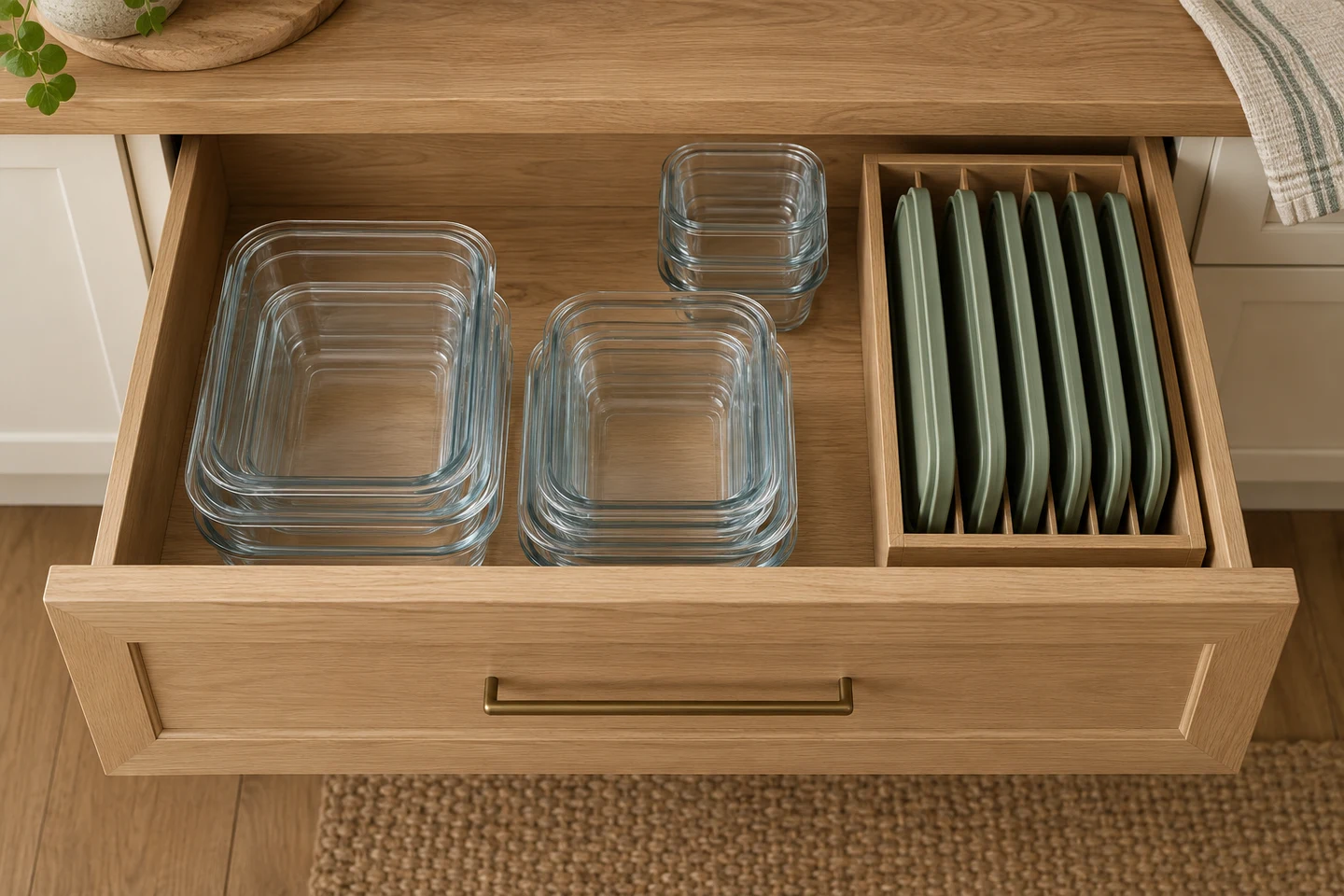
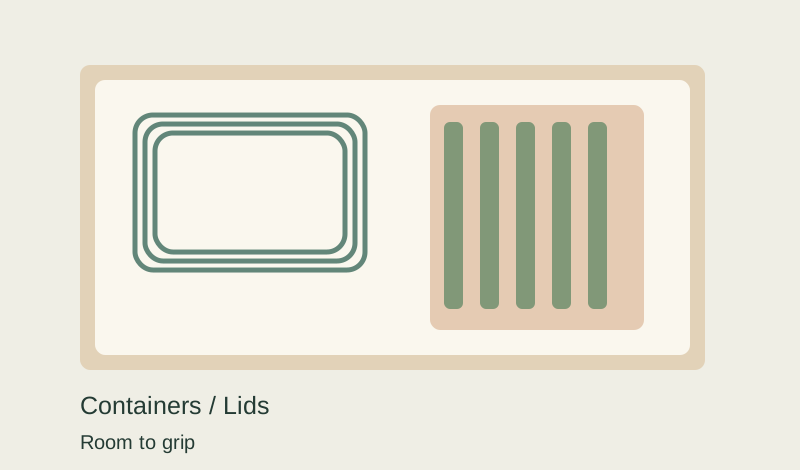
In a drawer: nest containers and stand lids upright.
Nest only sizes that fit together and separate easily. Keep round and rectangular formats apart and avoid one tall tower containing every size. Two or three shorter stacks are easier to use. Stand lids beside them by size so their edges are visible from above.
The example 16 cm lid zone may accommodate a 14.5 cm wide holder if lids and feet stay within the zone. IKEA VARIERA 701.548.00 is 14.5 cm wide, 10 cm high and adjustable from 8.5 to 50 cm in length according to its manufacturer. The chosen length and loaded height matter: 50 cm would not fit a 45 cm depth. The spacing may not suit small lids; check that they stand securely.
Try it at homeRemove the bottom container. If you must dismantle neighbouring stacks every time, split the group or keep that frequently used pair assembled.
Check manufacturer specifications
A freestanding lid holder
Useful if lids stand securely and the loaded arrangement fits. IKEA VARIERA is the dimensional example above; no confirmed Amazon listing is assigned to it.
Check manufacturer specifications ↗Search similar solutions on Amazon.de ↗Ad / affiliate link · search results, not a verified individual offer
Optional accessory
A divider for your drawer
Only needed if the lid zone moves when you open it. Try an existing narrow box first; compare outer size, grip and drawer height.
Search similar solutions on Amazon.de ↗Ad / affiliate link · search results, not a verified individual offerCupboard layout
In a cupboard: lift out a group instead of hiding a second row.
A deep shelf invites you to add more containers behind the first row. That is where occasional sizes disappear. Use a removable container group and a separate lid box instead. Keep everyday pairs at the front and heavier glass containers low down in manageable stacks.
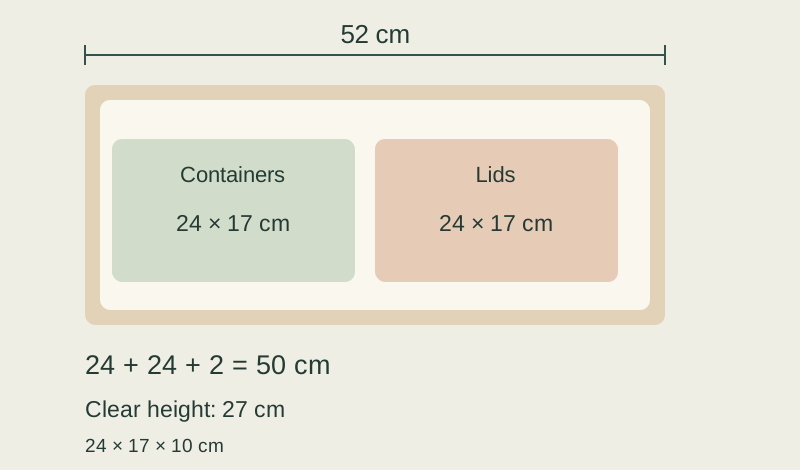
Example: a shelf 52 cm wide, 30 cm deep and 27 cm high can take two boxes with 24 × 17 cm outer footprints side by side: 24 + 24 + a 2 cm gap = 50 cm. There is 2 cm left at the sides in total. IKEA UPPDATERA 205.464.67 measures 24 × 17 × 10 cm according to its manufacturer. These are external measurements, not usable internal space. Check your largest containers, the opening between the doors and room to lift out each box.
Try it at homeTry two baskets or cardboard boxes you already own. Can you pull out one group with one hand without moving the other?
Check manufacturer specifications
A low removable box
Helps bring a group out of a deep shelf. IKEA UPPDATERA is the example above. The Amazon link searches similar boxes and does not promise that IKEA model.
Check manufacturer specifications ↗Search similar solutions on Amazon.de ↗Ad / affiliate link · search results, not a verified individual offer
Everyday set
Keep an everyday set that is easy to put back.
Lunchboxes for the next morning can stay with their matching lids. Reserve containers can be nested. Put cleaned containers into closed stacks only after they have dried fully, following their care instructions. For delicate glass, check the manufacturer’s stacking guidance instead of forcing pieces together.
Use the width of your fixed zones as a limit: if they fill up, check duplicate formats first. Add a size for a specific missing job rather than a large mixed set of unrelated lids. After a normal week, check three things: can you find the lid directly, remove the container and put it back?
Try it at homePack a portion using your usual pair. If nothing needs searching for or rearranging, your system works beyond a freshly tidied photograph.
Optional accessory
A small compatible container set
Add only a missing size. Check which lids fit which containers in the selected set: the same brand or a similar appearance is not enough.
Search similar solutions on Amazon.de ↗Ad / affiliate link · search results, not a verified individual offerOptional accessory
A separate group of glass containers
Choose for the intended use. Check weight, footprint, care and permitted stacking; use small accessible groups rather than a tall tower.
Search similar solutions on Amazon.de ↗Ad / affiliate link · search results, not a verified individual offer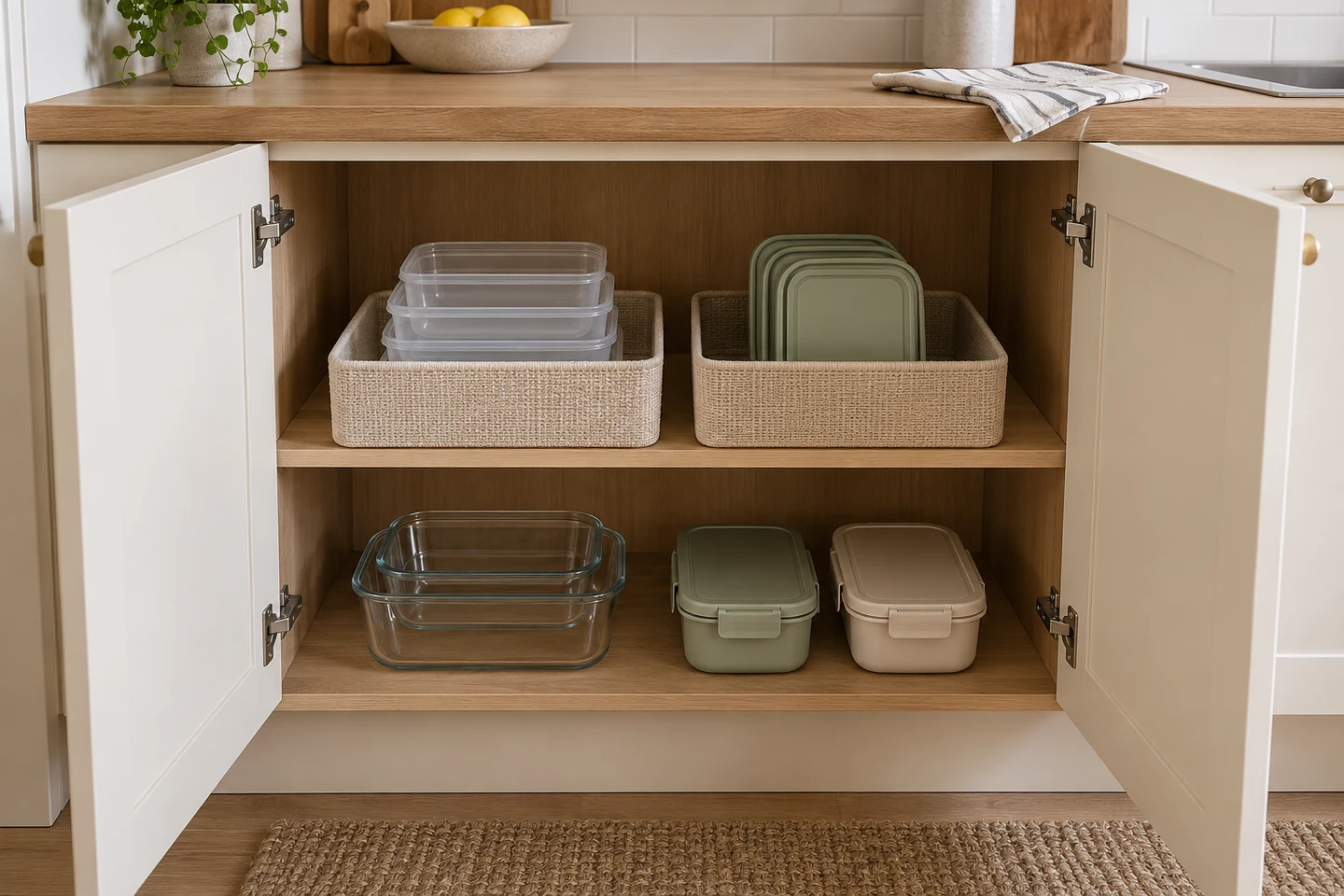
Cupboard shelf / Everyday set
Every container. A matching lid.
Lunchboxes for the next morning can stay with their matching lids. Reserve containers can be nested. Put cleaned containers into closed stacks only after they have dried fully, following their care instructions. For delicate glass, check the manufacturer’s stacking guidance instead of forcing pieces together.
06 / Choose a system
Which layout suits your routine?
| Situation | Starting layout | Check first |
|---|---|---|
| Wide drawer | Containers left, upright lids alongside | Loaded height and room to grip |
| Shallow drawer | Flat lids separated by size | Avoid one confusing mixed stack |
| Deep cupboard shelf | Two removable groups | Door opening, grip and box internal dimensions |
| Lunchbox used daily | One or two assembled pairs | Less nesting for quicker access |
Accessories for a specific job
The links search for accessories in the German Amazon store. They do not confirm the availability of the named IKEA example or the dimensions of any result. Check the selected variant, actual outer and inner dimensions, seller, delivery and price in the listing. Buy only after a trial with your existing set reveals a specific missing function.
CHECKLIST
Before buying: five checks
If something still gets in the way
Should I store every container with its lid closed?
That can be convenient for daily lunchboxes. For reserve storage, suitable nested containers may save space. Try both arrangements, keep containers dry and follow care instructions.
How many containers do I actually need?
Count those being used, filled or waiting to be washed at the same time. Base your everyday set on that number. The example of eight is a starting trial, not a universal recommendation.
Can a pan-lid holder work for small plastic lids?
Sometimes, if spacing, stability and total height suit them. Small lids may tip or slip through. A narrow box you already own may work better.
Do I need new containers for a tidy kitchen?
Not automatically. Resolve incomplete pairs and separate formats. New containers make sense if a particular job is missing or the existing set is no longer usable.
Good organisation is easy to put back.
Start with your existing containers and a cardboard layout. A small working set is more useful than a full cupboard that is clear only immediately after tidying.
Next: organise kitchen drawers →How this guide was prepared
Original planning examples and general organisation tips, not product tests. Manufacturer measurements for VARIERA 701.548.00 and UPPDATERA 205.464.67 were checked on 10 October 2026. Drawings are schematic; photographs are AI visualisations. The checklist applies to this visit only and does not save your choices.